● TAC 2.1 / Available in Canada
Exterior Technologies Group
Product TAC 2.1
SYS-01 / Rainscreen Sub-Framing System

Thermal
Spacer.
TAC

The TAC Thermal Spacer is the specified thermal bridge solution for Canadian rainscreen cladding — three clip families (steel, aluminum, glass-fibre-reinforced) that cut thermal bridging by up to 97% in exterior wall assemblies.

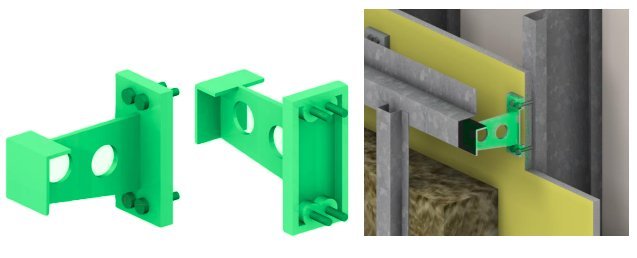
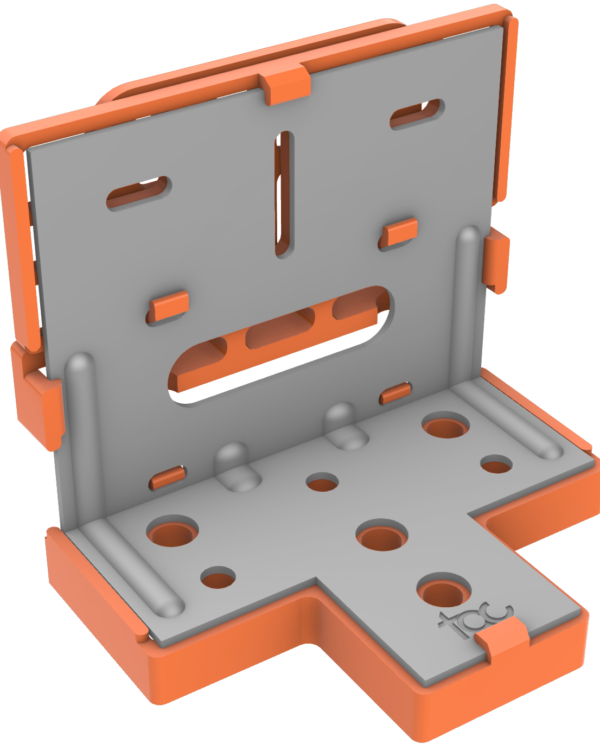
TAC 2.1 Thermal Assembly Clip — 14GA galvanized steel rainscreen sub-framing with HDPE thermal pad
Up to
97%
Thermal Bridging Reduction
Up to
27.7 R
Effective R-Value
3 CLIPS
Steel · Aluminum · GFRC
3–7"
System Depth Range

TAC 2.1: Thermal spacer engineered for rainscreen cladding.

Cold-formed A653 CS Type-B G90, 14GA galvanized steel with slotted HDPE thermal pads.

// 01

Adaptable Orientation

Vertical or horizontal installation.

// 02

Insulation Versatility

Adjustable thermal pad fits varied insulation thicknesses.

// 03

Non-Combustible

Tested to CAN/ULC S-134.

// 04

High-Load Capacity

Stiffening ribs handle high-wind and dead-loads.

// 05

Built-In Adjustability

1/2" tolerance. No third-party shims.

// 06

Certified

Verified thermal and structural testing.

Three thermal clips. One mission: stop thermal bridging.

The TAC family covers every project condition — choose by R-value target, combustibility requirement, and substrate.

High Load TAC Aluminum cast aluminum thermal assembly clip for rainscreen cladding — wall assembly detail
// 02

TAC Aluminum

Cast aluminum for demanding wind loads and high-performance assemblies.

Up to
21.3 R
Effective R-Value
  • Material Cast Aluminum
  • Combustibility Non-Combustible
  • Orientation Vertical & Horizontal
  • Clip Depth 3", 4", 5", 6"
  • Max Wind Load 60 PSF (32"×26" spacing)
Request Spec Sheet
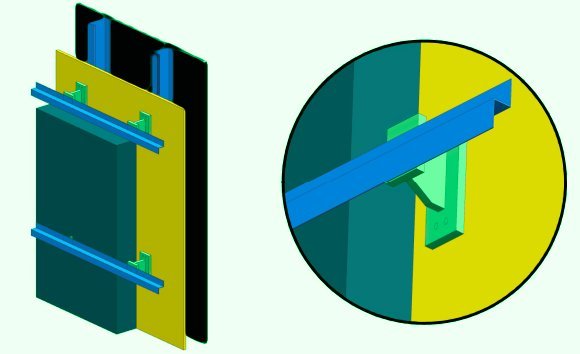
Highest R-Value TAC GFRC glass fibre reinforced thermal assembly clip — rainscreen sub-framing isometric detail
// 03

TAC GFRC

Glass fibre reinforced clip — maximum thermal performance for combustible assemblies.

Up to
27.7 R
Effective R-Value
  • Material Glass Fibre Reinforced
  • Combustibility Combustible
  • Orientation Vertical & Horizontal
  • Clip Depth 3", 4", 5", 6"
  • Max Wind Load 60 PSF (32"×26" spacing)
Request Spec Sheet

Inspect the thermal assembly clip in 3D.

Rotate, zoom, and inspect the TAC 2.1 in real time.

Revit Family files, 3D files, CSC specifications, and component drawings available on request.

Request Revit Files
Live Model / TAC 2.1

Model by Corearch Inc. on Sketchfab

Tested thermal, structural, and fire performance.

Third-party tested for thermal, structural, and fire performance.

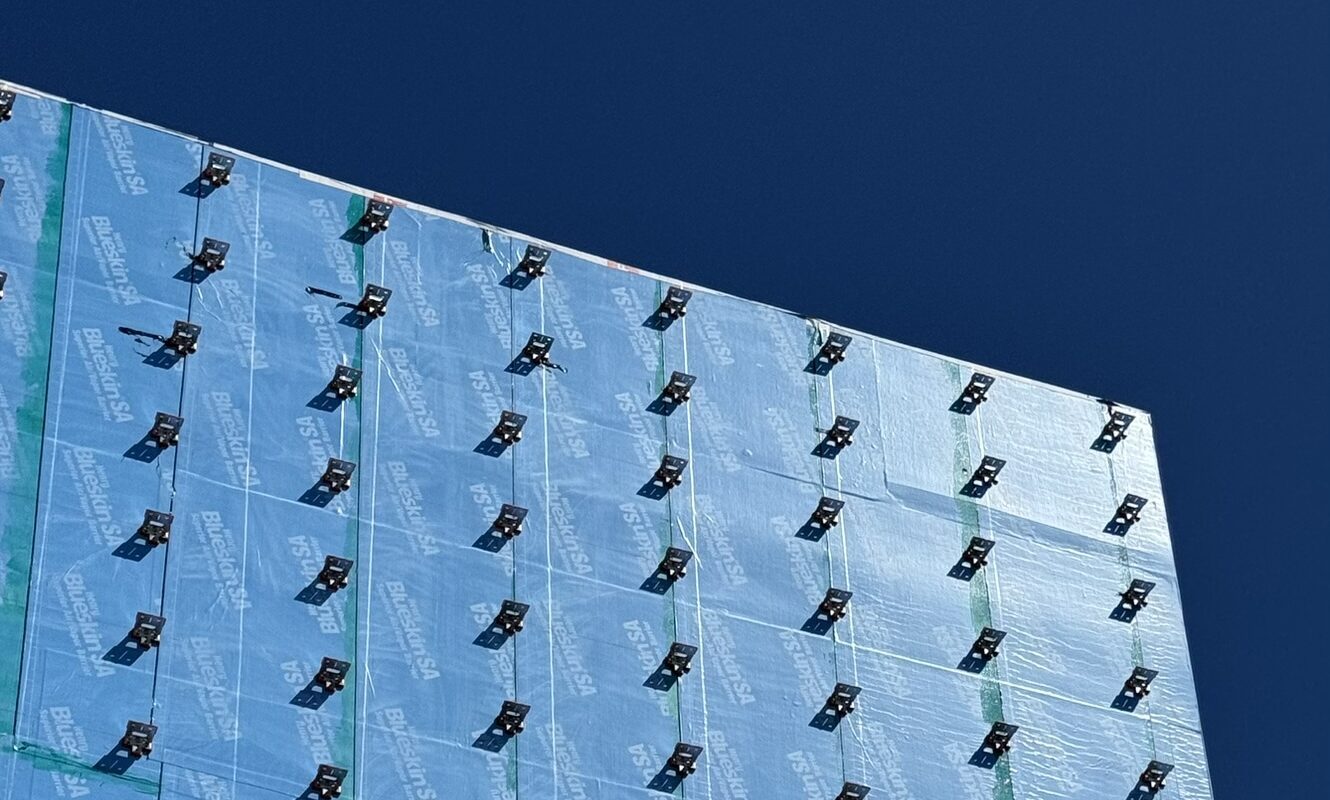
Field Install
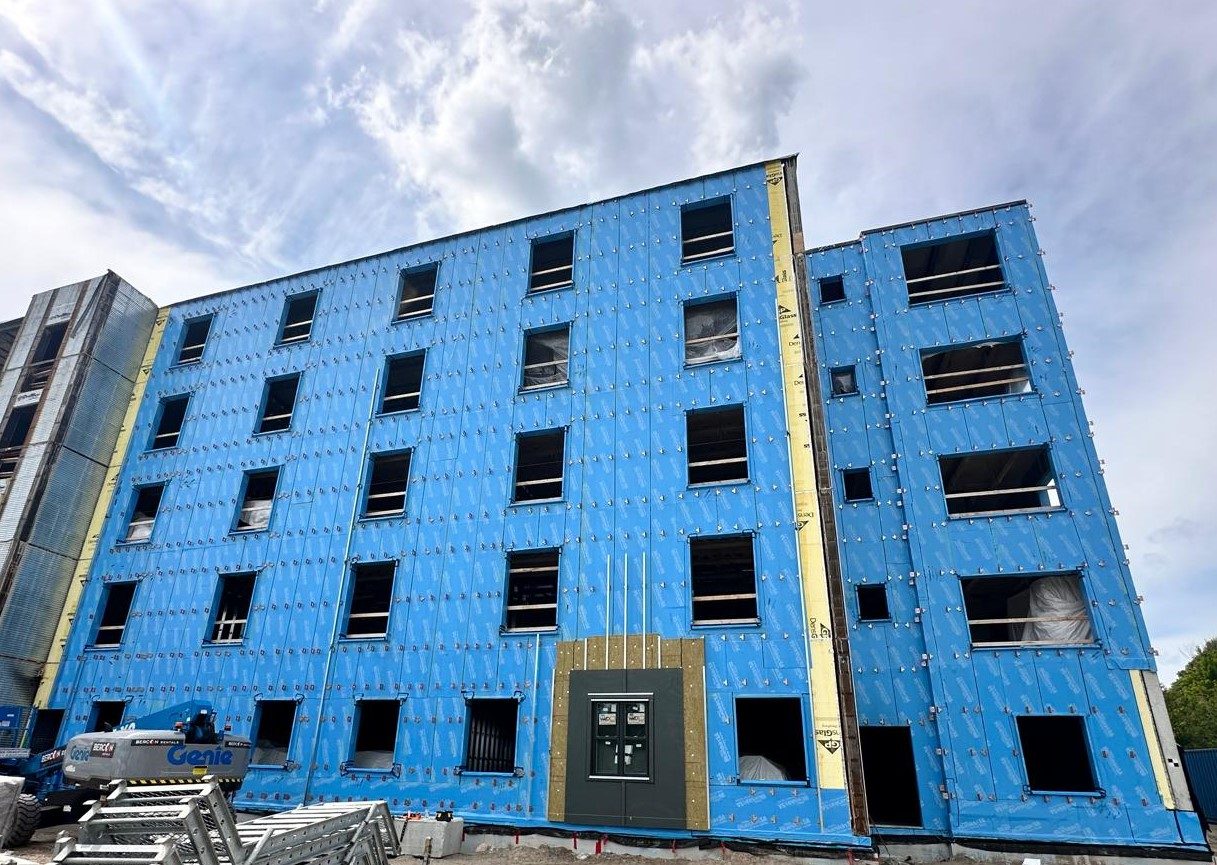
TAC 2.1 thermal assembly clips installed across a multi-storey rainscreen façade with BlueSkin air/vapour barrier
  • P/01
    System Depth 4" to 7" rainscreen range.
  • P/02
    Thermal Performance Up to 23.1 effective R-value. Up to 97% reduction in thermal bridging.
  • P/03
    Orientation Vertical and horizontal supported.
  • P/04
    Thermal Pad Slotted HDPE pad for field tolerance.
  • P/05
    Load Performance Cold-formed reinforcement for high loads.
  • P/06
    Fire Rating Non-combustible. CAN/ULC S-134.

How the TAC Thermal Spacer eliminates thermal bridging in rainscreen cladding.

A thermal bridge is any building component that conducts heat across the insulation plane — drastically reducing the effective R-value of an otherwise well-insulated wall. In rainscreen assemblies, the cladding support sub-framing is the dominant thermal bridge. The TAC thermal spacer is engineered to interrupt that bridge.

// 5.1 — The Problem

What is thermal bridging?

Thermal bridging occurs wherever a conductive element — steel, aluminum, concrete — penetrates the insulation layer and creates a low-resistance path for heat flow. In a continuous-insulation rainscreen wall, conventional Z-girt and hat-channel sub-framing systems penetrate the insulation continuously, conducting heat from the interior to the exterior cladding.

The result: a wall designed for R-25 insulation may deliver an effective R-value of only R-12 to R-15, because thermal bridges short-circuit the insulation. ASHRAE 1365-RP and the BC Hydro Building Envelope Thermal Bridging Guide document this gap extensively.

// 5.2 — The Solution

How a thermal spacer works.

A thermal spacer (also called a thermal break clip or thermal assembly clip) inserts a low-conductivity element between the structural cladding support and the substrate. The TAC system does this three ways:

TAC 2.1 Steel uses a slotted HDPE thermal pad between a galvanized steel clip and the substrate. TAC Aluminum uses a polypropylene thermal isolator between cast aluminum and the structure. TAC GFRC is itself a low-conductivity glass-fibre-reinforced polymer — the clip body is the thermal break.

// 5.3 — The Data

Verified thermal performance.

Morrison Hershfield modelled the TAC system using 3D finite-element analysis calibrated to ASHRAE 1365-RP hotbox testing (validated to within ±5%). Here are the effective R-values for a 16″ × 24″ o.c. clip spacing with split-insulated steel stud assembly:

ConfigurationNominal REffective R
TAC 2.1 Steel · 6″ depthR-25.2R-23.1
TAC Aluminum · 6″ depthR-25.2R-22.9
TAC GFRC · 6″ depth (split-insulated)R-25.2R-27.7
// 5.4 — The Comparison

TAC vs. conventional Z-girt sub-framing.

A conventional galvanized Z-girt penetrating R-25 mineral wool insulation typically delivers an effective wall R-value of R-12 to R-14 — losing roughly half the nominal insulation value to thermal bridging.

The TAC thermal spacer recovers that loss. With identical R-25 insulation, the TAC system delivers up to R-27.7 effective depending on the clip variant — up to 97% thermal bridge reduction verified by third-party engineering analysis.

Source: Morrison Hershfield Limited — Thermal Performance of TAC Aluminum Clip System (Report 180569000, 2020) and Thermal and Structural Performance of the Thermal Assembly Clip System (Report 5130385.00, 2013). Methodology per ASHRAE Research Project 1365-RP and the BC Hydro Building Envelope Thermal Bridging Guide.

Specification support for architects and engineers.

ETG provides spec consultation, custom detailing, and field review on every project.

Standard details, CSC specifications, and component drawings available on request.

Talk to a Specifier
Steel Studs
Verified
Cast-In Concrete
Verified
CMU
Verified
Façade Detail
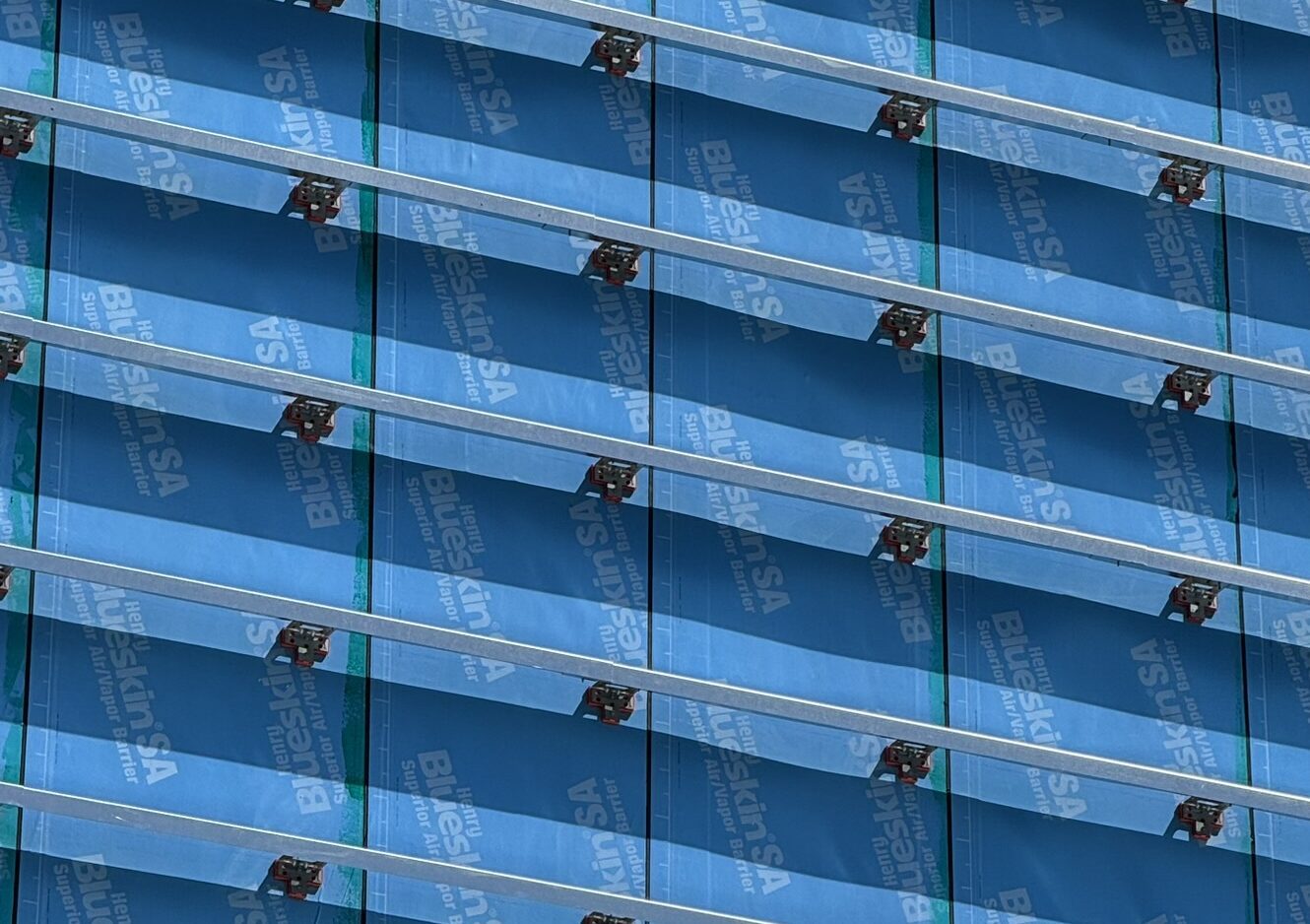
Close-up of TAC 2.1 thermal assembly clips mounted on a façade air/vapour barrier with horizontal rainscreen sub-framing

TAC 2.1 brochures, specs, and documentation.

Brochures, installation guides, and master specifications.

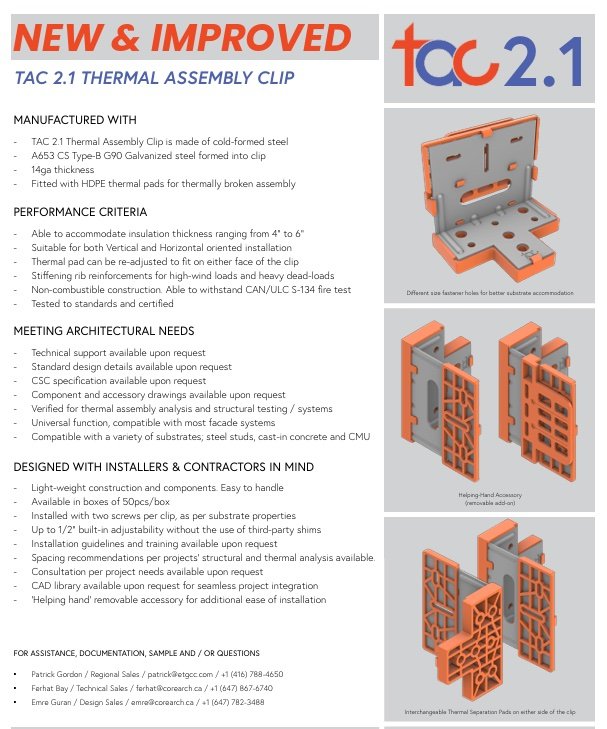
PDF
TAC 2.1 Thermal Assembly Clip product brochure cover
DOC-01 · Product Brochure
TAC 2.1 Brochure
Product overview and features.
Download PDF
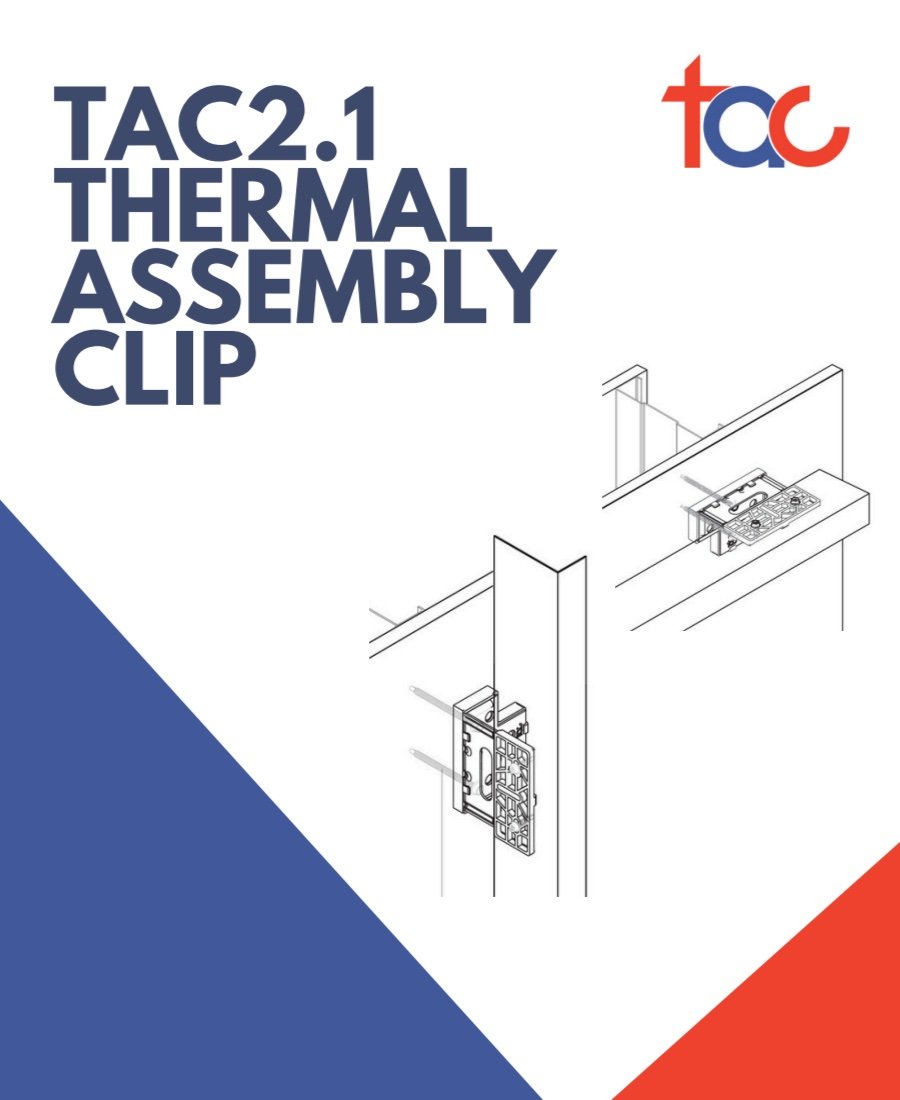
PDF
TAC 2.1 Thermal Assembly Clip catalogue and installation guide cover
DOC-02 · Catalogue & Install
TAC 2.1 Catalogue
Catalogue with installation guidance.
Download PDF
DOC
SECTION 07 05 43 CSC MASTER SPECIFICATION CLADDING SUPPORT SYSTEMS — TAC 2.1 PART 1 — GENERAL 1.01 Section Includes 1.02 References 1.03 Submittals PART 2 — PRODUCTS 2.01 Manufacturers 2.02 Materials 2.03 Components PART 3 — EXECUTION 3.01 Examination 3.02 Installation 3.03 Field Quality Control EXTERIOR TECHNOLOGIES GROUP
DOC-03 · CSC Master Spec
Master Specification
Editable CSC-format spec document.
Download DOCX
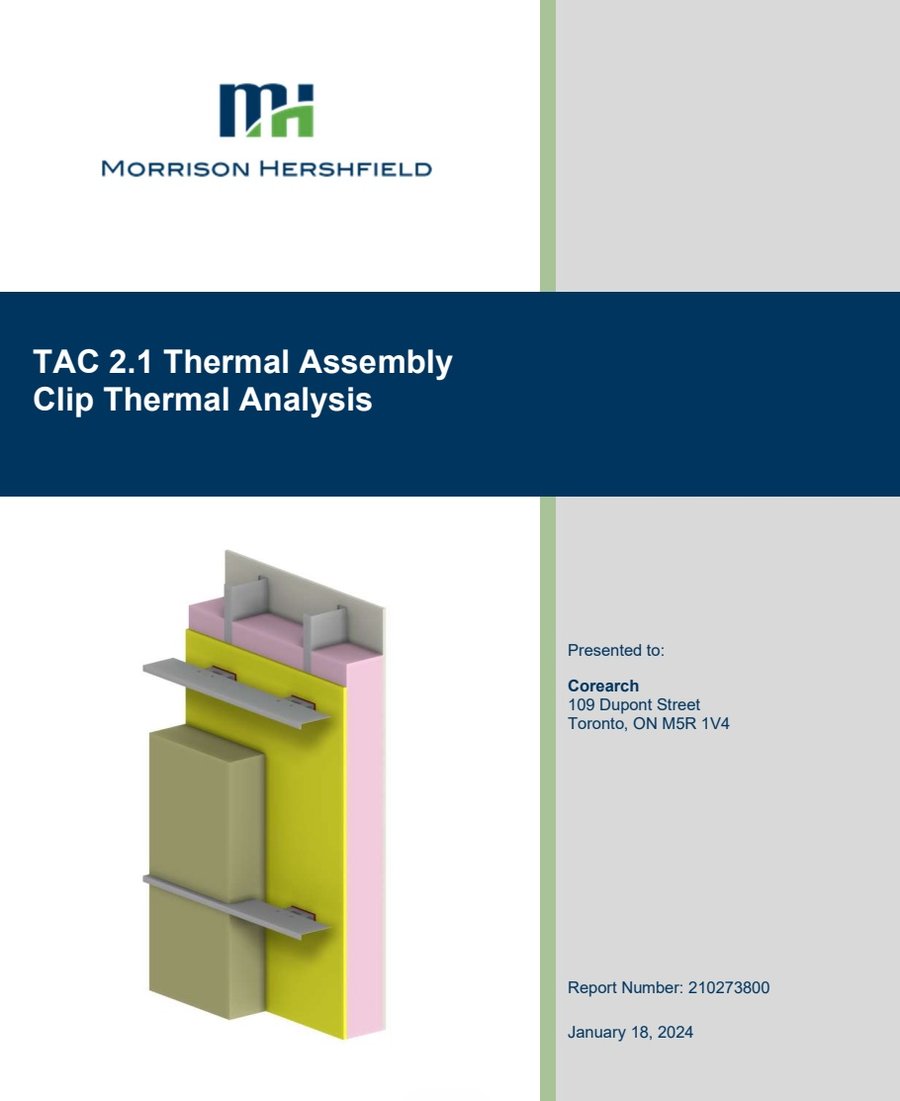
REQ
TAC 2.1 Thermal Analysis report cover by Morrison Hershfield
DOC-04 · Engineering Data
Thermal Analysis
Morrison Hershfield report. On request.
Request Access
REQ
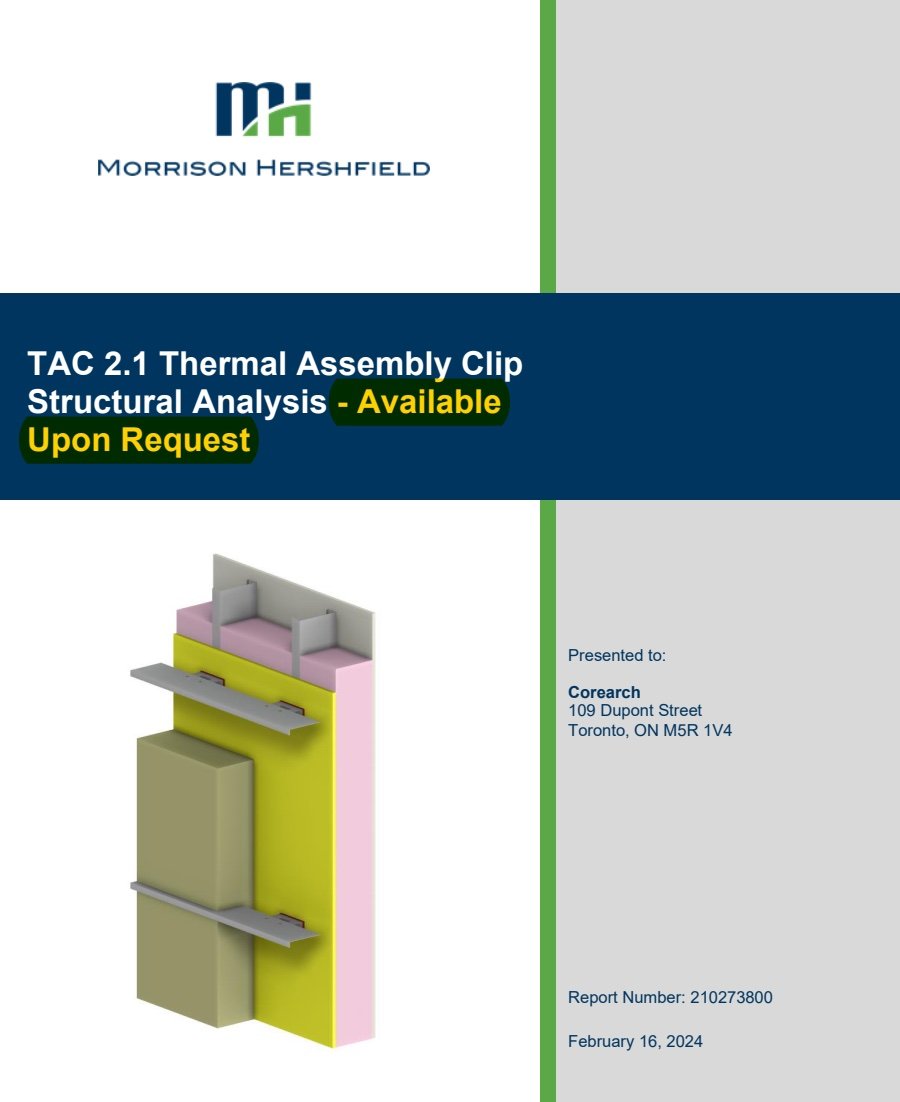
TAC 2.1 Structural Analysis report cover by Morrison Hershfield
DOC-05 · Engineering Data
Structural Analysis
Morrison Hershfield report. On request.
Request Access
REQ
3D FILES / BIM REVIT FAMILY · IFC · DWG REVIT & 3D FILES EXTERIOR TECHNOLOGIES GROUP
DOC-06 · BIM & 3D Files
Revit & 3D Files
RVT, IFC, and DWG formats.
Request Access
PDF
TAC ALUMINUM DOC-07 / THERMAL ANALYSIS REPORT TAC ALUMINUM CLIP R-VALUE (UP TO) 21.3 MATERIAL CAST ALUMINUM COMBUSTIBILITY NON-COMBUSTIBLE CLIP DEPTH 3", 4", 5", 6" MAX WIND LOAD 60 PSF Specifications · Details · Installation EXTERIOR TECHNOLOGIES GROUP
DOC-07 · Morrison Hershfield Report
TAC Aluminum Clip — Thermal Analysis
U-values, effective R-values, and temperature profiles for cast aluminum clip assemblies.
Download PDF
PDF
TAC SYSTEM REPORT DOC-08 / THERMAL + STRUCTURAL TAC FIBREGLASS CLIP R-VALUE (UP TO) 27.7 MATERIAL GFRC COMBUSTIBILITY COMBUSTIBLE CLIP DEPTH 3", 4", 5", 6" MAX WIND LOAD 60 PSF Specifications · Details · Installation EXTERIOR TECHNOLOGIES GROUP
DOC-08 · Morrison Hershfield Report
TAC System Report — Thermal & Structural
Full thermal and structural analysis of the fibre-reinforced TAC system across substrates.
Download PDF
Need something specific? Contact our spec team for project-specific files.
Get in Touch

Specify a TAC clip on your next envelope.

Pricing, technical support, and design assist from your Canadian distributor.

About the TAC Thermal Spacer.

What is the TAC Thermal Spacer?
The TAC Thermal Spacer is a family of rainscreen sub-framing clips that reduce thermal bridging in exterior wall assemblies by up to 97%. It is available in three variants: TAC 2.1 Steel (non-combustible 14GA galvanized steel, up to 23.1 R-value), TAC Aluminum (non-combustible cast aluminum, up to 21.3 R-value), and TAC GFRC (glass fibre reinforced, up to 27.7 R-value).
Which TAC thermal clip should I specify?
Choose TAC 2.1 Steel for code-driven non-combustible projects requiring the most-specified solution. Choose TAC Aluminum for demanding wind-load conditions where non-combustibility is still required. Choose TAC GFRC when maximum R-value (up to 27.7) is the priority and the assembly permits combustible components.
How does the TAC thermal spacer reduce thermal bridging?
The TAC clip uses a thermal break — either an HDPE pad on the steel clip or the inherent low conductivity of aluminum or glass fibre — between the structural fastening and the substrate. This interrupts the conductive path, achieving up to 97% reduction in thermal bridging compared to standard Z-girt or hat-channel sub-framing.
Are the TAC clips non-combustible?
TAC 2.1 Steel and TAC Aluminum are both non-combustible. TAC 2.1 has been tested to CAN/ULC S-134. TAC GFRC (Glass Fibre Reinforced Clip) is combustible and is intended for assemblies that permit combustible components.
Where can I buy TAC Thermal Spacers in Canada?
All TAC thermal clips — Steel, Aluminum, and GFRC — are distributed across Canada by Exterior Technologies Group (ETG). Contact ETG at (844) 240-0452 or info@etgcc.com for pricing, project consultation, Revit files, and AutoCAD details.
What is the maximum R-value of the TAC family?
The TAC GFRC delivers the highest effective R-value at up to 27.7. TAC 2.1 Steel achieves up to 23.1, and TAC Aluminum achieves up to 21.3. All values are based on third-party thermal analysis by Morrison Hershfield.

The TAC Thermal Spacer family is engineered for high-performance rainscreen cladding assemblies on commercial, institutional, and multi-residential projects across Canada. Three thermal clip variants — TAC 2.1 Steel, TAC Aluminum, and TAC GFRC (glass fibre reinforced clip) — allow architects and engineers to match the right thermal break to each project's combustibility, wind-load, and R-value requirements. As thermal spacers and cladding support clips, they support a wide range of cladding materials including metal panels, terracotta, stone, fibre cement, and composite systems. Distributed in Canada by Exterior Technologies Group, every TAC clip is backed by spec consultation, Revit Family files, CSC master specifications, and project-specific design assist.